
Las Vegas Local Search for Qualified Service Inquiries
Plan Las Vegas local search with accurate business information, useful service pages, reliable inquiry handling and qualified-opportunity measurement.
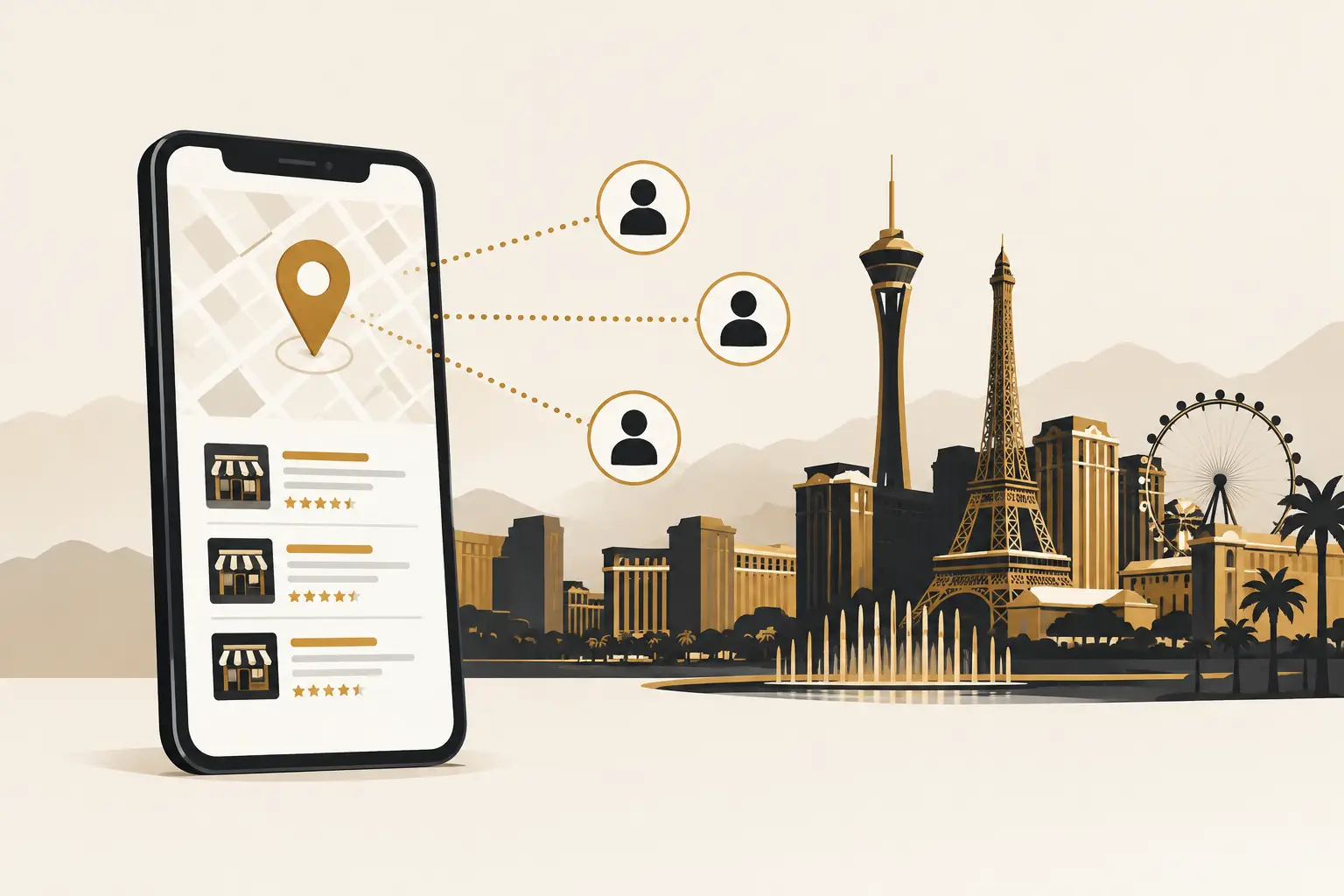
A Las Vegas local search strategy is only useful when it helps the right person find your business, understand why you fit their need, and take a trackable next step. A map listing that creates calls nobody answers, or a service page that attracts inquiries outside your service area, is not a growth system. It is a leak.
For established service businesses, the work is not simply “show up on Google.” It is to connect local visibility with a credible website, clear service information, reliable inquiry capture, and follow-up that does not depend on someone remembering to call back between appointments.
What Las Vegas local search really means
Local search is the set of results people see when their query signals a nearby or location-specific need. That may include map results, business profiles, organic service pages, review snippets, and answers surfaced directly in the search experience. A prospect searching for a provider near Summerlin, Henderson, or the Las Vegas Valley is usually trying to solve a practical problem, not conduct broad research.
That urgency changes what a good strategy looks like. A local prospect needs to quickly confirm four things: you provide the service they need, you serve their location, your business appears credible, and contacting you will be easy. Search visibility earns attention. The customer journey determines whether that attention becomes an appointment.
Las Vegas adds a few useful distinctions. Some businesses depend on residents and repeat customers. Others serve visitors, convention traffic, property owners, or commercial clients across Southern Nevada. A strategy built around “near me” searches may suit one business but be less useful for another that needs to win higher-consideration projects across a broader service area. The right geography follows the way customers actually buy.
Start with demand, not a list of neighborhoods
The common local SEO mistake is producing thin pages for every neighborhood, ZIP code, and nearby city. Those pages often repeat the same claims with a place name swapped out. They provide little value to customers and create a weak foundation for long-term search performance.
Instead, identify the combinations of service, location, and urgency that matter to your sales team. A business may need one strong page for a core service, a separate page for a specialized or commercial offering, and clear service-area language where it helps a buyer make a decision. The page should answer practical questions: what the service includes, who it is for, what happens after an inquiry, and whether the business can serve that customer’s location.
This is also where trade-offs matter. A company with a true walk-in location should prioritize accurate location details, directions, and hours. A business that travels to customers needs to be precise about its service area without presenting a virtual office as a staffed storefront. A national firm may need local credibility in Las Vegas while keeping its primary website architecture focused on broader markets. There is no single page structure that fits all three.
Match pages to buying intent
A search for a broad service is different from a search for a specific repair, consultation, installation, or recurring service. Treating them as identical can create confusing pages and low-quality inquiries.
Each important page should make a deliberate choice about its intended action. For a high-value service, that might be a consultation request with qualifying questions. For urgent work, a prominent call option may be more appropriate. For a business with a sales process, the form should collect enough information to route the inquiry correctly without asking for a full project brief before the first conversation.
A conversion-focused page does not need excessive copy or dramatic claims. It needs clear language, proof that is appropriate to share publicly, a visible next step, and a page experience that works well on a phone.
Treat your Google Business Profile as an operating asset
Your Google Business Profile is often the first public touchpoint for a local prospect. Its business name, category choices, hours, phone number, website destination, services, photos, and reviews should agree with the information on your website and in the way your team actually operates.
Accuracy is more valuable than cosmetic activity. If the phone number routes to a line that goes unanswered, the profile is creating a poor customer experience. If the hours fail to reflect scheduling availability, customers may contact you when no one can respond. If the profile points to a generic homepage rather than the most relevant service path, you lose context at the moment of interest.
Review management belongs here too, but it should not become a script-driven exercise. Ask for feedback as part of a consistent customer process, after an appropriate point in the relationship. Respond professionally to reviews where a response is useful. Patterns in feedback can reveal operational issues, such as unclear expectations, delays in communication, or confusion around the service process.
Avoid shortcuts such as inaccurate categories, fabricated locations, or incentives that pressure customers into positive reviews. Those tactics create risk and do not fix the underlying issue: whether customers can easily understand and work with your business.
The missed-call problem is a local search problem
Local demand often arrives by phone. That is especially true for time-sensitive services, appointment-driven businesses, and buyers who want confirmation before committing. Yet many local search programs stop at the call button, as though a ring equals a qualified lead.
It does not. A caller who reaches voicemail, receives a late response, or has to repeat their details across multiple systems may move on quickly. The same is true for web forms that send an email but never create an assigned task, a follow-up sequence, or a clear owner.
A dependable setup connects the contact point to the next operational step. Calls and forms should be captured, the inquiry should enter the correct pipeline, and the team should know who owns the response. For some businesses, an AI receptionist or chat workflow can help gather initial details and route leads outside normal hours. That only works when the workflow reflects real availability, service boundaries, and escalation rules. Automation should make the handoff more dependable, not hide a broken sales process.
The Montoya Growth OS can support this connection between lead capture, pipelines, scheduling, reviews, and follow-up. The appropriate configuration depends on the business, its existing tools, and the service process. A local SEO engagement and a full operations implementation are not the same scope.
Measure the path from search to qualified inquiry
Traffic and ranking reports can be useful diagnostics, but they are not the final measure of local search quality. A better question is whether the business can identify which search-driven inquiries became conversations, appointments, opportunities, and customers.
Start with a small set of definitions your team can use consistently. What qualifies as an inquiry? When does it become a booked appointment? Which leads are outside the service area, outside budget, or seeking a service you do not offer? Without those definitions, reporting can make more activity look like more progress.
Then connect source data to the customer journey. A prospect may first find a map listing, visit a service page, call later from a different device, and book after a follow-up text. Attribution will never be perfect, particularly with privacy controls and offline conversations. But a disciplined system can still show patterns: which pages produce qualified form submissions, which call sources generate appointments, and where response time is slowing conversion.
Technical site audits also have a place. Page speed, crawlability, mobile usability, and structured data can affect whether search engines and customers can access key information. Audit scores are technical diagnostics, not proof that a business will rank higher or generate more revenue. Use them to prioritize real issues, not as a scoreboard.
A practical 90-day priority order
Most businesses do not need to overhaul every local-search asset at once. The stronger sequence is to fix the journey in the order customers experience it.
First, confirm that your business profile, website contact details, service areas, hours, and primary calls to action are accurate. Next, improve the pages tied to your highest-value local services, including the forms, calls, and scheduling paths those pages use. Then establish a repeatable process for lead routing, response, review requests, and reporting.
Content and authority-building work can continue over time, but it performs best when the fundamentals are stable. There is little value in creating more demand for a page that sends visitors to an unmonitored inbox.
When local search needs more than SEO
Local search may not be the primary growth channel for every business. If your buyers come mainly from referrals, partnerships, repeat contracts, or a specialized procurement process, search may play a supporting role. The goal is not to force every company into the same channel mix. It is to make the local demand you do earn easier to capture and easier to manage.
For businesses that depend on calls, appointments, and consultations, the practical question is simple: when a qualified Las Vegas prospect finds you, does your system make it easy to become a customer? Build from that answer. Visibility is worth pursuing when the next step is ready to carry the weight.
Separate local visibility from a promised outcome
Google explains local ranking in terms of relevance, distance and prominence. Complete information can help Google understand a business, but an agency cannot control a searcher’s location or buy a better local ranking. A service-area setting is not a promise to rank throughout that area.
Local search works best when visibility leads to a clear inquiry path and an accountable response. For choosing the scope of an SEO engagement, use our Las Vegas local SEO buyer guide.
What should a useful service-area page contain?
Describe the actual service, relevant coverage limits, customer questions and the next step. Use real project evidence only when approved for public sharing. Google’s people-first content guidance supports useful, reliable information; repeatedly swapping place names does not add useful local evidence.
How should we check local-search lead quality?
Review a sample of calls and forms against service fit, coverage, assigned owner and documented outcome. A click on a phone number does not prove a connected conversation, and an appointment request does not prove a confirmed booking.
Review one local inquiry from discovery to response
Discuss local search with The Montoya Group. Bring your priority service, real service area and the inquiry path customers use. We can help connect appropriate visibility work with accountable intake and follow-up.