
How to Measure Lead Sources and Qualified Inquiries
Measure lead sources from first inquiry to qualified appointment and customer. Use clear source fields, practical formulas and honest attribution limits.
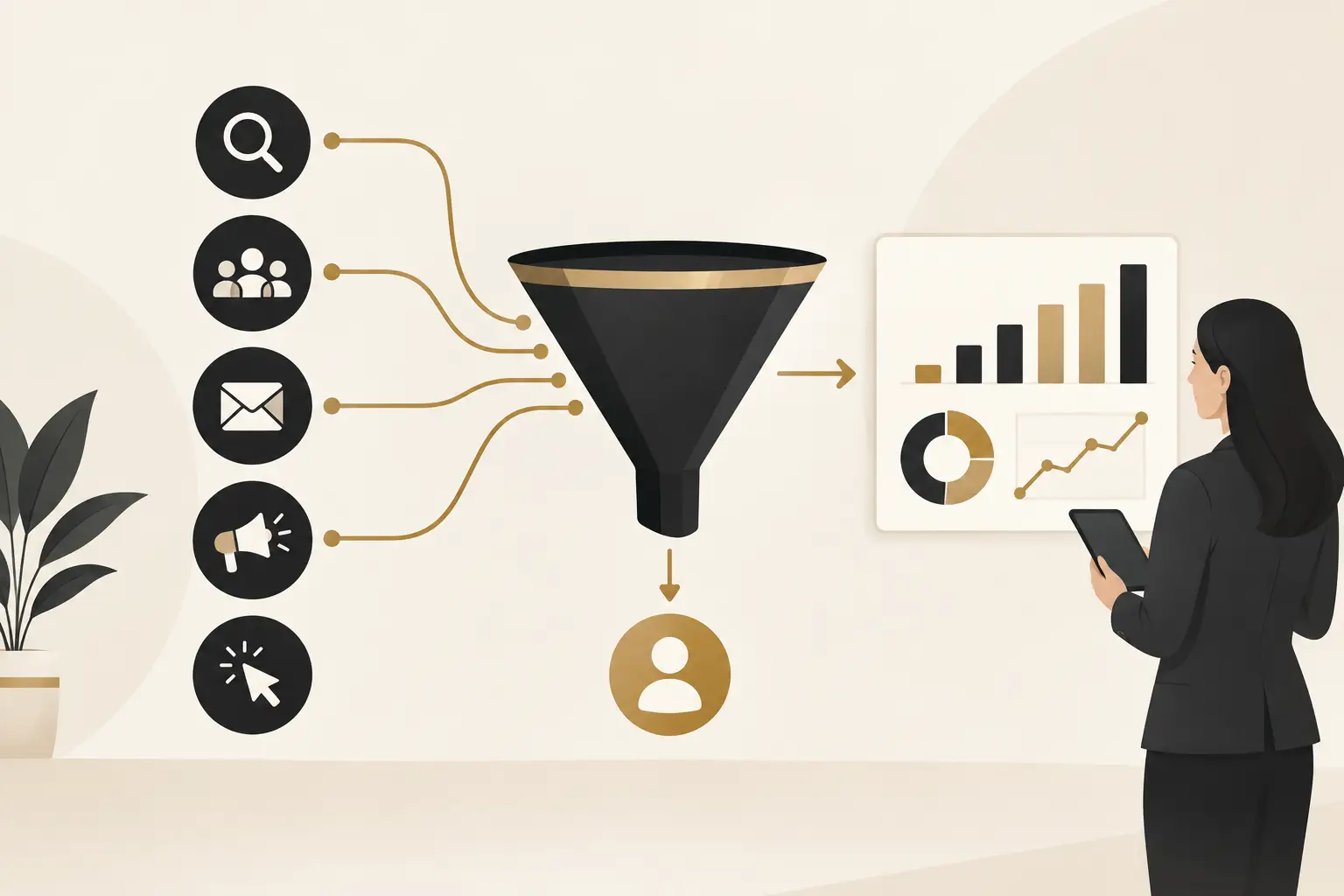
To measure lead sources, preserve the original source, campaign and entry page when available, then connect each inquiry to a CRM record and business outcome. Report source separately from conversion method, and keep unknown or consent-limited attribution visible rather than guessing.
For established service businesses, attribution is not a marketing report for its own sake. It is how you decide which channels deserve more budget, which need operational fixes, and which produce inquiries that actually become customers.
Start with the decision you need to make
Before adding tracking codes or changing your forms, define the decisions your reporting should support. A business owner may need to know whether local search is producing booked appointments. An operations leader may need to see which channels generate leads that are difficult to reach. A marketing team may need to compare website inquiries with paid campaign leads.
Those are different questions, and one report rarely answers all of them well.
A useful lead-source measurement system should let you answer four practical questions:
- Where did the inquiry first come from?
- What action did the person take to become a lead?
- Did your team contact, qualify, and book that lead?
- Did the opportunity become a customer, and if so, what was the value?
Traffic alone is not enough. A channel can generate many website visits and very few relevant inquiries. Another may create fewer leads but a higher percentage of qualified appointments. The better channel depends on your capacity, sales process, margins, and growth goals.
Define lead sources before your reporting becomes messy
Most attribution problems begin with inconsistent naming. One team member enters “Google,” another enters “SEO,” and a third selects “website.” Those labels may all describe the same journey, but they cannot be compared reliably in a report.
Create a small source taxonomy that reflects how customers realistically find your business. Keep it simple enough for sales and front-office teams to use correctly. For many service businesses, this includes:
- Organic search, including local map listings and unpaid website results
- Paid search, paid social, and other paid campaigns
- Referral partners and word-of-mouth referrals
- Direct website visits, branded searches, and offline marketing
- Email, social media, events, or other named campaigns
Then separate the lead source from the conversion method. The source might be organic search, while the conversion method is a phone call, contact form, web chat, text message, or appointment request. This distinction matters because a weak conversion method can make a strong marketing source appear ineffective.
For example, if organic search creates plenty of phone calls but those calls are missed after business hours, the issue is not necessarily visibility. It may be call handling, routing, or follow-up.
How to measure lead sources across every inquiry path
A complete system captures attribution wherever an inquiry begins. That includes the website, tracked phone calls, scheduling tools, chat conversations, review platforms, and manually entered leads from referrals or events.
Capture website and campaign data at the point of conversion
Website forms should pass useful context into your CRM or lead-management system. At minimum, capture the landing page, referring source, campaign information when applicable, and the date and time of submission. If someone arrives from a tagged campaign, those campaign details should follow the lead record rather than remain isolated in an analytics platform.
Use consistent campaign naming for paid ads, emails, QR codes, and social promotions. If naming changes every month or differs between the ad platform and CRM, reporting becomes a cleanup project. Establish a naming convention before campaigns launch and use it across creative, landing pages, forms, and reports.
Do not over-collect data that no one will use. A small set of clean fields is more valuable than dozens of incomplete fields.
Track calls without losing the human context
Calls are often a major source of qualified service inquiries, especially for businesses with urgent, high-consideration, or locally driven demand. Yet calls are frequently attributed only as “phone,” which says nothing about what caused the call.
Call tracking can associate calls with a website session, campaign, or local listing when it is configured carefully. Your team should still ask callers how they heard about you. The caller’s answer can reveal context that tracking misses, such as a personal referral, a podcast mention, or a recommendation from a past customer.
Treat self-reported attribution as a supporting field, not the only source of truth. A caller may say “Google” after finding your business through a map listing, a review, or a branded search. That answer is useful, but it is broader than a properly recorded first touch.
Include chat, text, and scheduling activity
Chat and AI receptionist conversations need the same attribution discipline as web forms. When a visitor begins a chat, the lead record should retain the page and source information that preceded it. If the conversation is transferred to a team member or turns into a booked appointment, that status should update in the same record.
Scheduling tools can also create blind spots. If an appointment is booked through a separate calendar without a lead record, your team may see appointments but not the source that produced them. Connect the scheduling event to the contact and opportunity whenever possible.
The Montoya Growth OS is designed to help businesses keep these steps connected: capture inquiries, route leads, follow up consistently, and measure outcomes in one operating view. The exact setup should reflect the channels and sales process your business actually uses.
Track the stages after the lead arrives
Attribution should not stop at form submission or call completion. A source that produces leads your team cannot reach is different from one that produces poor-fit inquiries. Without pipeline stages, both can look like “low quality” in a marketing report.
Use clear, operational definitions for each stage. A practical pipeline may include new inquiry, contacted, qualified, appointment booked, proposal or estimate sent, won, and lost. Not every business needs every stage, but the definitions must be consistent.
Ask your team to record a reason when an opportunity is lost or disqualified. Keep the options useful: outside service area, wrong service, price mismatch, no response, timing, existing provider, or another specific reason. This helps distinguish a targeting issue from a sales-process issue.
Response time deserves its own measurement. If two lead sources generate similar inquiries but one receives a first response within minutes and the other waits until the next day, you are not comparing marketing channels fairly. Operational follow-up changes conversion results.
Choose an attribution model that matches reality
There is no single perfect attribution model for every business. First-touch attribution credits the initial channel that introduced the lead. It is useful for understanding demand creation, especially when considering SEO, local search, content, or awareness campaigns.
Last-touch attribution credits the final interaction before the lead converted. It can help identify which page, offer, or campaign prompted action. But it can overvalue branded searches or retargeting that occurred after another channel built the initial interest.
For many service businesses, a practical approach is to retain both first source and latest source, then report on outcomes by first source. This gives leadership a clearer view of which channels create demand while still showing which actions helped close the gap to conversion.
For longer sales cycles, also review assisted touches. A referral may start the conversation, a website visit may validate credibility, and an email sequence may prompt the booking. Assigning all value to one touchpoint can be misleading. The goal is not mathematical perfection. It is a decision-quality view of the customer journey.
Build a monthly source-to-customer report
Your monthly report should move beyond lead volume. For each source, review inquiries, contact rate, qualified leads, booked appointments, opportunities, won customers, and revenue or estimated pipeline value when those figures are reliable.
Also review conversion rates between stages. In a hypothetical comparison, if paid search produces 20 leads and 10 booked appointments, while another channel produces 20 leads and two appointments, the difference is material even before customer value is known.
Be careful with small sample sizes. Three leads from a new referral partner do not establish a trend. Use the report to spot questions worth investigating, then consider the sales notes, call quality, landing page, offer, and follow-up process behind the numbers.
Common measurement mistakes to avoid
The most common mistake is relying on analytics traffic reports while sales outcomes live somewhere else. Another is allowing staff to overwrite original source fields as a lead moves through the pipeline. Preserve the original source, and use separate fields for later interactions.
Businesses also lose attribution when leads are manually added without a required source field, when calls are not logged, or when duplicate contact records split the same customer journey across multiple entries. These are process problems, not just software problems.
Finally, do not confuse a technical tracking setup with certainty. Cookie consent choices, privacy settings, cross-device browsing, offline conversations, and delayed conversions can all limit precision. Good measurement acknowledges those limits while still providing a more dependable basis for action.
The best next step is usually not a larger dashboard. Start by tracing ten recent leads from first contact through outcome. Where did the source disappear? Where did follow-up slow down? Fix those breaks first, and your reporting will become useful enough to guide real growth decisions.
A small source-to-outcome measurement model
Use consistent definitions and the same reporting period before comparing channels. These are suggested operational formulas; they do not imply that a channel caused every recorded outcome.
| Measure | Calculation | Important boundary |
|---|---|---|
| Qualification rate | Qualified inquiries / eligible inquiries | Define eligibility and remove duplicate submissions |
| Booking rate | Confirmed appointments / qualified inquiries | A calendar-page visit is not a booking |
| Attendance rate | Attended appointments / appointments due in the period | Define cancellations and reschedules consistently |
| Cost per qualified inquiry | Attributable campaign spend / qualified inquiries | State whether management fees are included |
| Cost per new customer | Defined acquisition costs / new customers | Use consistent timing and account for the sales-cycle lag |
Keep original source, latest source and self-reported source in separate fields. Use a distinct conversion-method field for call, form, chat or booking. Treat direct and unknown as visibility limits rather than evidence of a specific channel.
What should campaign tags contain?
Use a documented naming convention for source, medium and campaign, adding other fields only when useful. Google's campaign URL guidance explains how campaign parameters appear in Analytics. Do not add campaign tags to ordinary internal navigation; preserve the visitor's acquisition context.
Can we prove that an AI recommendation created a customer?
Sometimes a referral or self-reported field identifies an AI source, but missing referrers, app transitions and cross-device journeys limit certainty. Preserve what you observed and ask a neutral attribution question; do not relabel unattributed traffic as AI-generated demand.
Connect measurement to the decisions you need to make
Discuss your lead-source reporting requirements. The Montoya Group can help scope Growth OS or an appropriate integration around your actual inquiry sources, ownership and customer outcomes.
Illustrative artwork; not a live product interface, client result or staff photograph.